Can style tags change an AI singer's voice? 14 tested
Our singing model has no preset singers; the voice comes only from text tags. We measured 14 voice tags: 8 kept, 4 dropped, none produced a child's voice.
By the MuziAI team. The numbers come from measurements we ran ourselves while building MuziAI; drafts were written with AI assistance, and every figure was checked against our measurement logs. Updated October 13, 2026.
There is no list of singers inside the model that sings your songs on MuziAI. The voice comes only from a few words in the style prompt, usually “female vocal” or “male vocal”. So if you write “husky”, “deep” or “kid singer” there, does the voice actually change? We tested 14 tag phrases, two generations each, and measured the separated vocals. The short answer: tags can move clarity, brightness and roughness, they barely control pitch, and no tag we tried produces a child's voice. Of the 12 variants beyond the two defaults, 8 became voice types on the site and 4 were dropped.
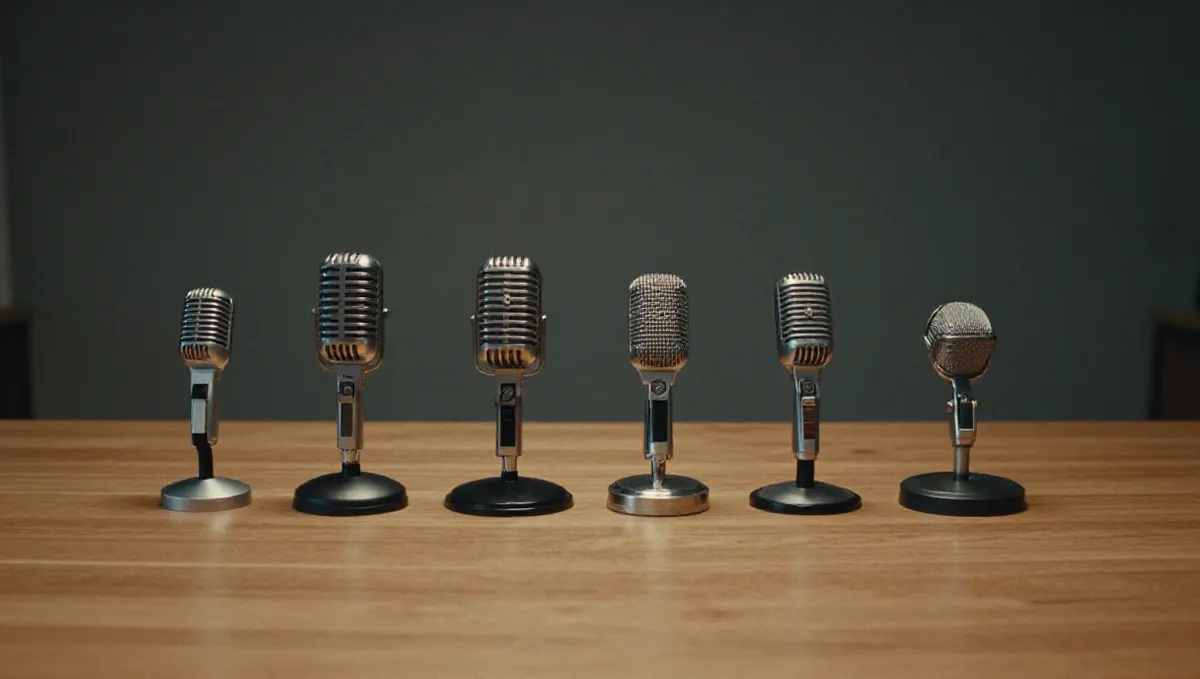
The model has no built-in voices
A request to the singing model carries exactly two things: a text description of the style and the lyrics. There is no singer ID and no way to pass a reference recording. The voice is whatever the model reads out of the words. So “choosing a voice” really means swapping “female vocal” or “male vocal” for a different tag phrase, and the question becomes measurable: which phrases change the voice, and which are just words?
The setup: 14 tag phrases (2 defaults plus 12 variants), each generated with two seeds (11 and 22), the same 8 lines of lyrics and the same backing description, “Pop ballad, piano, acoustic guitar, 84 BPM”, for songs of 40 to 60 seconds. We pulled the vocal out with our vocal separator and measured four things on the isolated voice:
- Pitch: median, in Hz.
- HNR (dB): harmonics-to-noise ratio. Higher means a cleaner tone, lower means more breath or grit.
- Energy above 4 kHz (dB): closer to zero is brighter, more negative is darker.
- Jitter (%): how much consecutive vocal-fold cycles differ in length. Higher sounds rougher.
The rule for keeping a tag: it must differ from the default in the same direction on both seeds. Each kept type is named after what we measured, not after the words in the tag.
The 14 tags, measured
Each cell holds two numbers: seed 11 · seed 22.
| Tag phrase | Pitch (Hz) | HNR (dB) | Above 4 kHz (dB) | Verdict |
|---|---|---|---|---|
| female vocal (default) | 291 · 294 | 21.2 · 20.2 | −17.8 · −18.2 | Baseline |
| bright clear soprano female vocal | 266 · 351 | 22.6 · 22.6 | −17.6 · −23.4 | Kept: Clear |
| soft sweet gentle female vocal | 300 · 295 | 18.9 · 18.1 | −16.7 · −17.4 | Kept: Sweet, soft |
| airy breathy whispery female vocal | 294 · 292 | 23.2 · 26.5 | −23.0 · −20.3 | Kept: Smooth, mellow |
| husky smoky female vocal | 262 · 351 | 19.5 · 18.2 | −20.6 · −21.9 | Kept: Husky |
| powerful belting diva female vocal | 260 · 360 | 19.9 · 19.1 | −13.7 · −17.5 | Kept: Powerful |
| warm low alto female vocal | 294 · 329 | 22.5 · 18.3 | −20.6 · −19.7 | Dropped |
| male vocal (default) | no singing · 214 | no singing · 18.7 | no singing · −16.6 | Baseline |
| bright high tenor male vocal | 263 · 292 | 21.9 · 21.0 | −19.2 · −19.3 | Kept: High, bright |
| warm baritone male vocal | 163 · 205 | 20.5 · 20.9 | −18.3 · −22.8 | Kept: Low, warm |
| soft gentle breathy male vocal | 189 · 220 | 21.8 · 22.6 | −17.3 · −24.0 | Kept: Soft, mellow |
| deep low bass male vocal | 187 · 197 | 20.8 · 21.8 | −16.8 · −16.0 | Dropped |
| raspy gritty rough male vocal | 220 · 220 | 18.4 · 19.4 | −18.7 · −17.1 | Dropped |
| powerful rock male vocal | 196 · 297 | 20.4 · 17.3 | −16.7 · −18.9 | Dropped |
What we did not expect:
- The words can point the wrong way. “airy breathy whispery” produced the darkest, cleanest voice in the female set (HNR 23.2 and 26.5 dB, above the default on both seeds), so on the site it is called “Smooth, mellow”. The male “soft gentle breathy” tag did the same: dark, clean, not breathy.
- The tag that really adds breath is “soft sweet gentle”: HNR 2.3 and 2.1 dB below the default, and brighter.
- “husky smoky” is genuinely husky: jitter 1.01% on both seeds (default 0.84 and 0.66), and HNR lower than the default on both.
- “powerful belting diva” carries more high-frequency energy than the default (+4.1 and +0.7 dB) and reached 526 Hz.
- The four dropped tags failed in different ways: “warm low alto” was not lower than the default and its HNR moved in opposite directions; “deep low bass” did the same thing as “warm baritone” without going any lower; “raspy gritty rough” was no rougher than the default (jitter 0.74 and 0.61 against 0.72); “powerful rock” went one way on one seed and the other way on the next.
A voice type is a category, not a singer
We scored speaker similarity with an independent voice-matching model, comparing two songs generated with the same type. The scores ranged from 0.49 to 0.82, about the same as two songs of different types. Pick Husky twice and you get two different husky singers, not one familiar artist. The site says this plainly: every song gets a new voice of the type you chose, close to the preview but not identical.
Second finding: tags do not steer pitch reliably. The same soprano tag landed at 266 Hz on one seed and 351 Hz on the other. The alto tag, which should sit lower, came out at 294 and 329 Hz, no lower than the default's 291 and 294. The vocal range follows the melody the model writes, not the words. Only the male set split cleanly into high and low: high tenor at 263 and 292 Hz, warm baritone at 163 and 205 Hz.
Child voices: four tags, none worked
People often want a children's song sung by a child. We tried four tag phrases, two seeds each, over a children's-music backing, with the same measurements plus vocal resonances (formants F2, F3 and F4, which give a voice its color), compared with “female vocal”.
| Tag phrase | Pitch (Hz) | F2 · F3 · F4, seed 11 | F2 · F3 · F4, seed 22 | Similarity to default female |
|---|---|---|---|---|
| child vocal, kid singer | 393 | +3.2 +2.0 +1.4 % | −0.3 −4.7 −3.6 % | 0.76 |
| young girl child vocal, cute kid voice | 376 | +2.4 −0.6 −0.0 % | −2.6 −3.3 −4.2 % | 0.71 |
| young boy child vocal, boy soprano | 329 | +2.9 −6.0 +0.1 % | +5.6 −3.3 −4.1 % | 0.66 |
| children's choir, kids singing together | 370 | +5.3 −2.2 −2.3 % | +2.8 −3.8 −1.2 % | 0.75 |
Real children's voices resonate 15 to 25% higher than adult female voices. Here the shifts stayed within about ±6%, and the two seeds disagreed on direction. Similarity to “female vocal” (0.66 to 0.76) was no different from the similarity between two generations of the same type (0.59 to 0.77). The pitches of 329 to 393 Hz look promising, but as the first table showed, pitch follows the melody, not the tag. Conclusion: text tags cannot turn the voice into a child's, so the site has no Kids voice type. Our children's-song template uses the Kids genre with the Clear voice type instead.
Limits and open questions
- Small sample: two seeds per type, 10 to 30 seconds of singing per song. Enough to drop a tag that goes two ways, not enough to promise a tag will “always” sound a certain way.
- The male side is weaker: on seed 11 the default “male vocal” barely sang at all (3.7 seconds), so the male comparisons rest largely on one seed.
- One backing, one set of lyrics: every number here comes from an 84 BPM pop ballad. Other genres have not been re-measured.
- These are acoustic measurements, not taste. “Cleaner” means a higher HNR, which is not automatically better for your song.
How to use this when you make a song
- Listen before you choose. Each type has a 12-second preview cut from the densest vocal passage of its own test song. Playing a preview does not select it.
- Pick by the measured trait: for a clean tone, “Clear” or “Smooth, mellow”; for breath and brightness, “Sweet, soft”; for grit, “Husky”; for big high notes, “Powerful”. Male voices: “High, bright”, “Low, warm”, “Soft, mellow”.
- Do not use a female voice type to set the key. If you want a higher or lower song, the voice type is not a reliable lever.
- Do not expect the same singer across songs. Each song is a new singer within the category. Generate a few versions and keep your favorite.
- For a children's song, choose the Kids genre and the Clear type. Typing “child vocal” into the style box will not give you a child.
- Writing your own tags? Remember the four that failed: “raspy” did not make the voice rougher and “alto” did not make it lower.
Try it now on MuziAI
Free, no sign-up required. Share an idea, and our AI lyrics generator writes and sings a complete song.
Create Song