How to Choose the Right Key for Your Voice: Find Your Range, Then Transpose the Song
Write down the lowest and highest notes you can sing comfortably, then find the lowest and highest notes of the song's melody. Move the whole song up or
By the MuziAI team. The numbers come from measurements we ran ourselves while building MuziAI; drafts were written with AI assistance, and every figure was checked against our measurement logs. Updated October 13, 2026.
Write down the lowest and highest notes you can sing comfortably, then find the lowest and highest notes of the song's melody. Move the whole song up or down until its top note lands at your comfortable top or a semitone below it, and check that its bottom note still sits above your comfortable bottom. Every chord moves by the same number of semitones, which you can count on a keyboard, read off a key chart, or get on guitar with a capo. Then sing the hardest phrase in the new key and adjust one semitone at a time until it feels easy.

Find your comfortable range, not your extreme range
Your comfortable range runs from the lowest note that still has a clear, steady tone to the highest note you can sing without pushing, squeezing or reaching up with your chin. It's narrower than the full range you can hit on a good day, and it's the only range that matters when you choose a key, because a song makes you sing its high notes again and again, often loudly.
How to test it with a keyboard
You need something that tells you note names: a piano, a keyboard app, or a tuner app that displays the note you're singing. Write every note with its octave number. Middle C is C4, the B just below it is B3, and the D just above it is D4. Some keyboards and music apps number their octaves differently, so check what yours calls middle C before you compare your notes with anyone else's.
- Warm up for five or ten minutes with easy humming and gentle slides. Don't test first thing in the morning or straight after shouting at a game.
- Start on a note in the middle of your speaking voice and sing it on "ah" or a hum.
- Walk down one key at a time. Stop when the tone turns breathy, creaky or very quiet. The last clear note is your comfortable bottom.
- Go back to the middle and walk up one key at a time. Stop at the first note where you feel tightness or have to sing louder to get there. The note before it is your comfortable top.
- Repeat the test on another day and keep the more conservative result.
Most people find their comfortable top sits a little below the highest note they can squeeze out. That gap is normal. Use the comfortable number.
Range versus tessitura
Tessitura is the part of your range where you can sing for several minutes without tiring, usually somewhere in the middle of your comfortable range. A song whose melody mostly lives in your tessitura feels easy even if it touches one high note in the bridge. A song that hammers the top of your range through a whole chorus will wear you out even if every single note is technically "in range". When you weigh a key, look at where the melody spends its time, not just its two end points.
Typical ranges for soprano, alto, tenor and bass
Voice types give you a rough idea of where your measured range sits. These are the typical full ranges; the part you can sing comfortably in a pop song often stops a few semitones short of the top.
| Voice type | Typical range |
|---|---|
| Soprano | C4 to C6 |
| Mezzo-soprano | A3 to A5 |
| Alto (contralto) | F3 to F5 |
| Tenor | C3 to C5 |
| Baritone | A2 to A4 |
| Bass | E2 to E4 |
The labels overlap, and real voices don't respect the borders. If your comfortable range is A2 to G4, you match the baritone range almost exactly, since a typical baritone runs A2 to A4 while a typical tenor only starts at C3. Teachers also judge voice type by where the voice sounds best and by its color, not by end points alone.
For picking a key, the label barely matters. Your own two notes do the work.
Find the song's range and its current key
You need three things from the song: its lowest melody note, its highest melody note, and the key it's in now.

If you have sheet music, read the range straight off the melody line. If you don't, pick the melody out on a keyboard. Check the high point of the last chorus (songs often climb there), any bridge or ad-lib line, and the lowest line of the verse. A tuner app works too: sing along with the recording and read the notes it shows at the top and bottom.
The key is usually the chord the song ends on and the note that feels like "home" when the melody comes to rest. If a chord chart starts and ends on G and G feels settled, the song is almost certainly in G major. If it ends on a minor chord such as Em and that chord feels like home, the song is in E minor.
While you're at it, note how long the melody stays near its peak. One high note on a held word is very different from a chorus that sits on the same three high notes for eight bars.
Work out how many semitones to move
An octave has 12 semitones, and each key on a piano (white or black) is one semitone from the next. Transposing a song by a number of semitones moves every melody note and every chord by that same number, so the shape of the song stays exactly the same.
To find the number, count the semitones from the song's top note to your comfortable top. If the song peaks at A4 and your comfortable top is F4, that's A4 to Ab4 to G4 to F#4 to F4, four semitones, so you move the song down 4. Then check the bottom: subtract the same 4 semitones from the song's lowest note and make sure the result isn't below your comfortable bottom.
A worked example
A singer has a comfortable range of B2 to F4. The song is in E major, and its melody runs from E3 in the verse to G#4 in the chorus.
- The song's top, G#4, is 3 semitones above the singer's top, F4.
- Moving down 3 would put the peak right on F4. Moving down 4 leaves one semitone to spare, which helps on the last chorus when the voice is tired.
- Down 4 semitones, the melody runs from C3 to E4.
- C3 is one semitone above the singer's comfortable bottom of B2, so the low end still works.
- E major moved down 4 semitones is C major. The singer plays the song in C.
The song spans 16 semitones and the singer's comfortable range spans 18, so there's room. When there isn't, you have a choice to make.
When the song's range is wider than yours
Some melodies cover more ground than your comfortable range. Shifting the key can't fix that; it only slides the problem from one end to the other. You have two honest options.
The first is to decide which end matters more. Usually it's the top, because high notes tend to sit on the loudest, most important words of the chorus, while the lowest notes are often a quick passing note in the verse. Set the key for the top and let the bottom be a little quiet.
The second is to change a few notes. Singers do this all the time: take one high note down to a note from the chord underneath it, or lift a very low phrase up an octave. A small change to two or three notes often saves you from choosing a key that makes the rest of the song sound strained or mumbled.
Transposing the chords with a key chart
Once you know the number of semitones, every chord moves by that number and keeps its type. A minor chord stays minor, a seventh stays a seventh. In the example above, moving down 4 turns E into C, A into F, B7 into G7 and C#m into Am.
This chart shows the 12 major keys moved up and down by up to 3 semitones. Find your original key in the middle column and read across.
| Down 3 | Down 2 | Down 1 | Original key | Up 1 | Up 2 | Up 3 |
|---|---|---|---|---|---|---|
| A | Bb | B | C | Db | D | Eb |
| Bb | B | C | Db | D | Eb | E |
| B | C | Db | D | Eb | E | F |
| C | Db | D | Eb | E | F | F# |
| Db | D | Eb | E | F | F# | G |
| D | Eb | E | F | F# | G | Ab |
| Eb | E | F | F# | G | Ab | A |
| E | F | F# | G | Ab | A | Bb |
| F | F# | G | Ab | A | Bb | B |
| F# | G | Ab | A | Bb | B | C |
| G | Ab | A | Bb | B | C | Db |
| Ab | A | Bb | B | C | Db | D |
Minor keys move exactly the same way: A minor down 2 is G minor, E minor up 3 is G minor. For moves of 4 to 6 semitones, read the chart twice, or count on a keyboard.
The chart uses the spellings most chord charts use: Bb rather than A#, Eb rather than D#, Ab rather than G#, and Db rather than C# for keys. F# and Gb are the same key and both spellings are common; pick whichever your band reads more easily. Inside a key, sharps go with sharp keys and flats with flat keys, so a song in F has a Bb chord, while a song in D has an F#m chord, not a Gbm.
Using a capo to change key on guitar
A capo raises the pitch by one semitone for every fret. Play the same open-chord shapes with a capo on the 3rd fret and everything sounds 3 semitones higher, so E shapes with capo 3 sound in G.
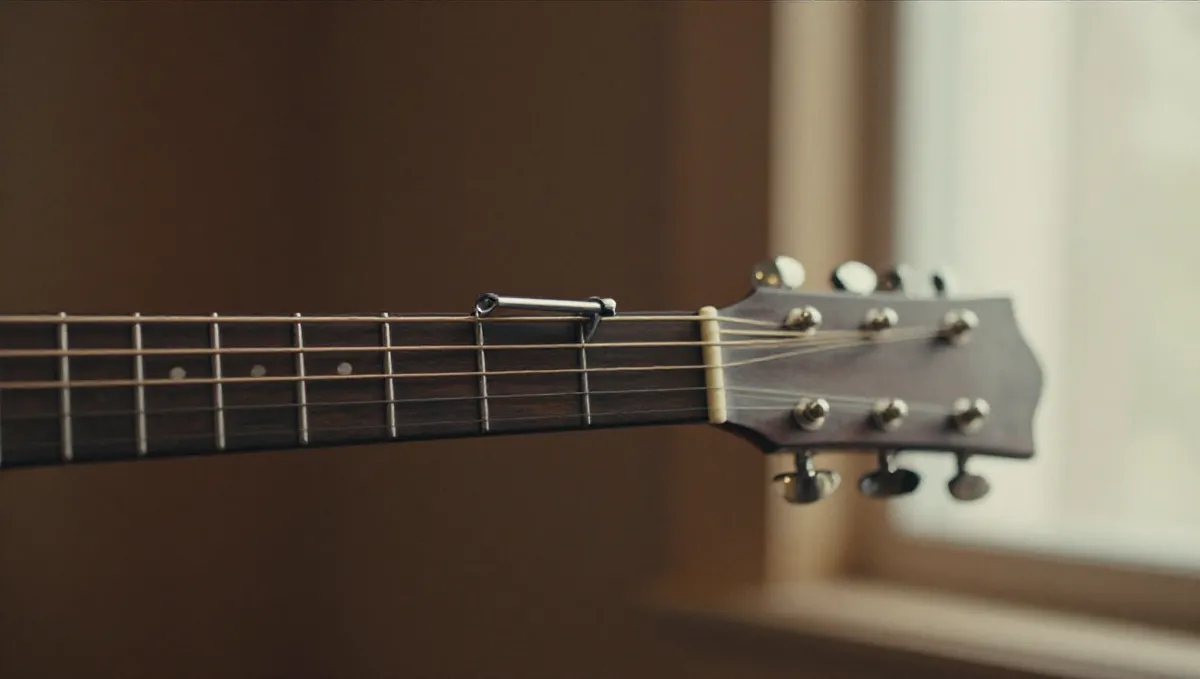
| Chord shapes | Capo 1 | Capo 2 | Capo 3 | Capo 4 | Capo 5 |
|---|---|---|---|---|---|
| C | Db | D | Eb | E | F |
| G | Ab | A | Bb | B | C |
| D | Eb | E | F | F# | G |
| A | Bb | B | C | Db | D |
| E | F | F# | G | Ab | A |
A capo can only take you up. To go down, switch to lower chord shapes and then add a capo to land exactly where you want. Say a song is in G and you want it in F, 2 semitones lower. F has awkward barre chords, but D shapes with the capo on the 3rd fret sound in F, and so do E shapes with the capo on the 1st fret. Both keep you on easy open chords.
A capo high on the neck (fret 7 and above) gives a thinner, brighter sound, so if you need it that high, look for a set of shapes that lets it sit lower.
Singing a song written for the other voice
Men's and women's voices typically sit around an octave apart, which is why a man and a woman singing "the same tune" are usually an octave apart. But taking a song in its original key and simply singing it an octave up or down often overshoots, because the two ranges don't line up note for note. The better fit is frequently a fourth or a fifth away (5 or 7 semitones) rather than a full 12.
Take a song written for a man that runs from C3 to G4 in C major. A woman with a comfortable range of F3 to D5 tries it an octave up: C4 to G5. The top is 5 semitones above her comfortable top, so that's out. Moving the original up just 5 semitones instead gives F3 to C5 in F major, which fits inside her range with room to spare at the top. Up 6 (F# major) would also work.
The same logic runs in reverse when a man covers a song written for a woman. Start by trying the original key, then the key a fourth or fifth lower, and only then a full octave down. Run the numbers with your own range rather than assuming one shift works for every song.
Test the new key before you commit
Numbers get you close, and your voice makes the final call. Before you print the chord chart, try this:
- Sing the hardest phrase of the song, usually the last chorus, three times in a row at full performance volume.
- Sing the lowest line of the verse and listen for whether it still carries.
- Record both on your phone and play them back. Strain is easier to hear on a recording than from inside your own head.
- If the top still feels like a reach, go down one more semitone and repeat. If the low line disappears, go up one semitone.
Test with the real accompaniment if you can, on a normal day rather than right after a long rehearsal. A key that only works when you're fresh will fail you halfway through a set.
Signs a key is wrong, and the mistakes people make
A key is too high when you notice your chin lifting toward the high notes, your throat tightening, or yourself singing louder just to reach them. Cracking on the same note every time, and a scratchy or hoarse voice after a short session, point the same way. A key is too low when the bottom notes go breathy, growly or so quiet they vanish under the guitar, and you find yourself pushing your chin down to reach them.

Singing too high now and then won't ruin your voice, but making it a habit adds up. If singing hurts, stop and rest. Hoarseness that lasts more than three weeks, or pain when you sing or speak, is a reason to see a doctor rather than push through.
These are the mistakes that most often lead to a wrong key:
- Choosing the key from the top note alone and ignoring how long the melody stays up there.
- Measuring your range on your best, most warmed-up day and treating that as normal.
- Lowering the song so far that the verses fall below your comfortable bottom and turn into a mumble.
- Keeping the original key because the recording is in that key. Professional singers routinely change keys to fit their own voices, especially live.
- Forgetting that the same singer may need different keys for a quiet ballad and a loud rock song with the same top note.
If you lowered a song and the low notes are now mumbly, you went too far. Move back up one semitone at a time, or keep the lower key and lift just the lowest phrase up an octave.
Will a different key change the song?
The melody, chords and rhythm stay exactly the same; only the pitch moves. What changes is how your voice sounds, because the song now sits in a different part of your range. A chorus that was a strained shout in the original key may become a strong, full sound a few semitones lower. Go too low and the same chorus can lose its lift. That's why the target is your comfortable top or just under it, not as low as possible.
For a duet or a group, write down everyone's comfortable range and find the overlap. Place the melody inside that shared zone, and if there isn't one, let each singer take the part of the song that suits them or sing in harmony instead of unison.
Your range isn't fixed for life. Regular practice usually makes the top easier and steadier over time, so re-test every few months and you may find a song you dropped by 3 semitones now works 1 semitone down. If you write songs of your own and try ideas on MuziAI, measuring your range first makes it easier to judge whether a melody will actually suit you.
Try it now on MuziAI
Free, no sign-up required. Share an idea, and our AI lyrics generator writes and sings a complete song.
Create Song