The I-V-vi-IV Progression Explained: Why Those Four Chords Feel So Familiar
I-V-vi-IV sounds satisfying because each chord has a different job. I is home, the most stable chord in the key. V carries the strongest pull back to home.
By the MuziAI team. The numbers come from measurements we ran ourselves while building MuziAI; drafts were written with AI assistance, and every figure was checked against our measurement logs. Updated October 13, 2026.
I-V-vi-IV sounds satisfying because each chord has a different job. I is home, the most stable chord in the key. V carries the strongest pull back to home. vi is a minor chord that shares two notes with home, so it sounds like a darker version of it. IV moves away from home, and from IV the loop drops straight back to I. The chords next to each other either share notes or move by small steps, so the changes sound smooth, and because the loop never lands on a hard stop it can repeat for an entire chorus. In the key of C, the four chords are C, G, Am and F.
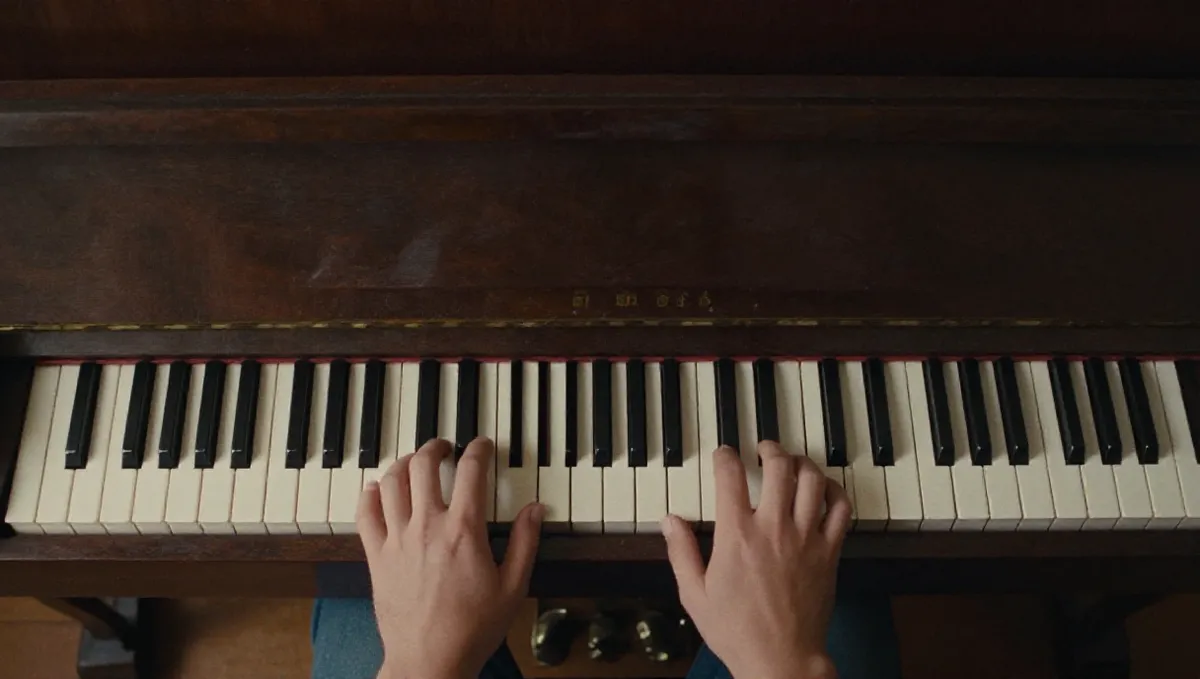
It feels familiar for a simpler reason: it uses only the three main major chords of a key plus one minor chord. That makes it one of the first progressions guitarists and pianists learn, and almost any melody in a major key will sit on top of it, so songwriters keep reaching for it.
What the Roman numerals in I-V-vi-IV mean
Each Roman numeral is a step of the major scale, and the chord is built on that step. Uppercase numerals mean a major chord, lowercase means a minor chord. So I-V-vi-IV reads as: the major chord on step 1, the major chord on step 5, the minor chord on step 6, the major chord on step 4.
Musicians use numerals instead of chord names because numerals describe relationships, not specific notes. "C, G, Am, F" only works in C. "I-V-vi-IV" works in every major key, which is why you see it in tutorials and comment sections: it tells you the shape of the progression no matter what key the song is in.
To see where the chords come from, take the C major scale: C D E F G A B. Build a three-note chord (a triad) on each note by stacking every other note of the scale. You get seven chords, and their quality (major or minor) falls out of the scale itself:
| Step | I | ii | iii | IV | V | vi | vii |
|---|---|---|---|---|---|---|---|
| Chord in C | C | Dm | Em | F | G | Am | Bdim |
| Notes | C E G | D F A | E G B | F A C | G B D | A C E | B D F |
This also answers a question beginners often ask: why is there a minor chord in a "major key" progression? Nobody chose to make vi minor. Stack the scale notes A, C and E and the distance from A up to C is a minor third, so the chord on step 6 of any major scale is minor. The same pattern repeats in every major key: steps 1, 4 and 5 give major chords, steps 2, 3 and 6 give minor chords, and step 7 gives a diminished chord.
I-V-vi-IV in C, G and D
Here are the chords in C, G and D:
| Key | I | V | vi | IV |
|---|---|---|---|---|
| C major | C (C E G) | G (G B D) | Am (A C E) | F (F A C) |
| G major | G (G B D) | D (D F# A) | Em (E G B) | C (C E G) |
| D major | D (D F# A) | A (A C# E) | Bm (B D F#) | G (G B D) |
You can work these out for any key in three steps:
- Write out the major scale of the key. G major is G A B C D E F#.
- Pick the notes on steps 1, 5, 6 and 4. In G that is G, D, E and C.
- Make the chords on 1, 5 and 4 major and the chord on 6 minor: G, D, Em, C.
The sharps come from the scale, not from the progression. G major has one sharp (F#), which shows up inside the D chord. D major has two (F# and C#), which show up in D, A and Bm.
Which key is easiest depends on your instrument. On guitar, G major is the friendliest: G, D, Em and C are all open chords. C major asks for an F, and D major asks for a Bm, and both are usually played as barre chords, which take a while for most beginners. On piano, C major uses only white keys. Pick the key that fits your voice, though, not only your hands. If the melody sits too high or too low, move every chord up or down by the same number of steps and the progression keeps its sound.
A common starting rhythm is one chord per bar in 4/4 time, which turns the four chords into a four-bar loop.
What each chord does in the loop
The progression works because the four chords play different roles relative to the home chord. Using the key of C:
C (I) is the rest point. It contains the note the key is named after, and a phrase that ends on it sounds finished.
G (V) is the chord of tension. It contains B, the seventh note of the scale, which sits a half step below C. That note is called the leading tone, and your ear expects it to rise to C. A G chord on its own sounds like a question waiting for an answer.
Am (vi) is the relative minor of C. A minor and C major share the same seven notes, and the Am chord (A C E) shares two of its three notes with the C chord (C E G). That is why vi can stand in for I without sounding like a change of key. It is home with the lights dimmed.
F (IV) moves away from home in a gentler way than V. It has no leading tone, so it does not demand to resolve. It opens the sound up, and it shares the note C with the home chord, which makes the step back to C easy.
Why the loop sounds so satisfying
Three chord changes do the work, and the move from G to Am matters most. After a V chord your ear expects I. The loop gives you vi instead. In theory this is called a deceptive cadence: the tension of G is released, but not in the expected place. It still feels like a resolution because the leading tone B does rise to C, which is in the Am chord, and Am contains two of the three notes of C. So the release arrives, just on a different chord than the one your ear predicted.
From Am to F, two notes stay where they are. A and C appear in both chords, so only one note has to move (E steps up to F). The change sounds soft, almost like the harmony is leaning rather than jumping.
From F back to C at the end of the loop, the note C again stays put. This IV to I move is the plagal cadence, the same motion as the "amen" at the end of a hymn. It is a gentle landing, not a forceful one, which is why the loop can go round again without feeling like the song has ended.
There is also a reason melodies fit so easily on top. The note C belongs to three of the four chords: it is the root of C, the third of Am and the fifth of F. A singer can hold or return to the home note over most of the loop and it will sound right. The same is true in every key, because the tonic note is part of I, vi and IV.
Why it feels so familiar
Part of the familiarity is built into the chords and part of it is exposure.

The chords themselves are the most basic material a major key has. I, IV and V are the three primary chords of the key, and vi is the closest minor chord to home. Almost every melody written in a major scale can be harmonized with some of these four, so the progression rarely clashes with what a singer wants to do. It also repeats every four bars, and four-bar and eight-bar phrases are the standard building blocks of pop verses and choruses, so the loop lines up with the way songs are already structured.
Then there is exposure. Because the progression is easy to play and easy to write over, songwriters keep returning to it, and the more often you hear it, the more "right" it sounds. When people notice that two unrelated pop songs sound alike, this progression is often the shared ingredient. The progression is sometimes called the "axis progression", a name taken from an Australian comedy band that built a routine around how many hit songs share it.
Four chords are not a song, though. A chord progression this common is a shared building block of music, in the same way that a verse-chorus structure is. What makes a song recognizable is its melody, rhythm, lyrics and arrangement.
Same four chords, different starting point
The same four chords can start on any of the four positions, and each starting point changes the mood:
| Order | In C | Character |
|---|---|---|
| I-V-vi-IV | C G Am F | Bright, starts at home |
| V-vi-IV-I | G Am F C | Starts with tension, lands on home at the end |
| vi-IV-I-V | Am F C G | Starts on the minor chord, sounds more wistful |
| IV-I-V-vi | F C G Am | Opens with a lift, ends unresolved on the minor chord |
vi-IV-I-V is the same loop, but starting on Am changes what your ear treats as the center. The first chord of a loop lands on the strongest beat and gets heard as the reference point, so a minor chord there colors everything after it. In fact, Am-F-C-G can be read as a progression in A minor (i-VI-III-VII), which explains why the same four chords suddenly sound sadder or more reflective.
A related progression uses the same chords in yet another order: I-vi-IV-V (C Am F G in C). It is often called the "50s progression" because doo-wop ballads relied on it heavily. Here V comes last, so the loop ends on the chord with the strongest pull home, and each repeat starts with a clear resolution to I. That gives it a more old-fashioned, closed-off sound than I-V-vi-IV.
How I-V-vi-IV differs from ii-V-I
ii-V-I is a cadence that drives toward one clear arrival on the home chord, while I-V-vi-IV is a loop that starts at home and circles around it.
| I-V-vi-IV | ii-V-I | |
|---|---|---|
| In C | C G Am F | Dm G C |
| In G | G D Em C | Am D G |
| In D | D A Bm G | Em A D |
| Shape | Four-bar loop that repeats | Three-chord move that lands on I |
| Strongest moment | V to vi (expected I, gets vi) | V to I (full resolution) |
| Typical home | Pop, rock, folk choruses | Jazz standards, also ends of phrases in many styles |
In ii-V-I, each chord root moves down by a fifth: D to G, then G to C. That chain of fifths builds steadily stronger pull, and the final V to I gives a complete resolution. In jazz it is usually played with seventh chords (Dm7, G7, Cmaj7), and players treat it as a unit that can appear in many keys within a single tune.
I-V-vi-IV avoids that full V to I resolution entirely. Its strongest move goes to vi, and its return home comes from IV. It never sounds like it is ending, so it can carry a pop chorus that repeats several times. If you want a phrase to sound finished, ii-V-I (or simply V-I) is the stronger tool. If you want something that can cycle under a melody, I-V-vi-IV does that better.
Making it your own
You can use I-V-vi-IV without sounding generic by changing how the chords are played, not which chords they are.

Change the rhythm and chord lengths first. Two bars on I and one bar each on V and vi, or a quick IV that lasts only two beats, will make the same chords feel very different from the even one-per-bar version.
Use inversions so the bass moves smoothly. Playing G with B in the bass (written G/B) gives a bass line of C, B, A, F, which walks down step by step instead of jumping.
Swap a chord. Em (iii) can replace G (V) for a softer, less pushy sound, giving I-iii-vi-IV. Dm (ii) can replace F (IV), because both lead away from home in a similar way.
Add color to the chords. Cmaj7, Am7, Fadd9 or Gsus4 resolving to G keep the same function while changing the texture.
A few mistakes come up again and again with beginners:
- Playing the vi chord as major (A instead of Am in C). The progression loses its shading and sounds off.
- Choosing a key for the hands, not the voice. If you have to strain to sing over it, transpose.
- Strumming all four chords with the same pattern and the same volume for the whole song. The loop is repetitive by design, so the variety has to come from rhythm, dynamics and the melody.
If you want to hear how a melody sits over these loops in different keys and moods, a music generator such as MuziAI is one quick way to try variations before you sit down at the instrument.
Try it now on MuziAI
Free, no sign-up required. Share an idea, and our AI lyrics generator writes and sings a complete song.
Create Song