Seventh Chords Explained: How Cmaj7, Am7 and G7 Differ From the Triads You Already Play
When you add a seventh, you stack one more third on top of the triad, so the chord goes from three notes to four: root, third, fifth and seventh. That new
By the MuziAI team. The numbers come from measurements we ran ourselves while building MuziAI; drafts were written with AI assistance, and every figure was checked against our measurement logs. Updated October 13, 2026.
When you add a seventh, you stack one more third on top of the triad, so the chord goes from three notes to four: root, third, fifth and seventh. That new note sits either 11 half steps above the root (a major seventh) or 10 half steps above it (a minor seventh). Which one you pick, and whether the triad underneath is major or minor, decides the chord. Cmaj7 (C E G B) is a major triad with a major seventh and sounds soft and open. Am7 (A C E G) is a minor triad with a minor seventh and sounds mellow more than sad. G7 (G B D F) is a major triad with a minor seventh, and it sounds restless because it wants to move to C.
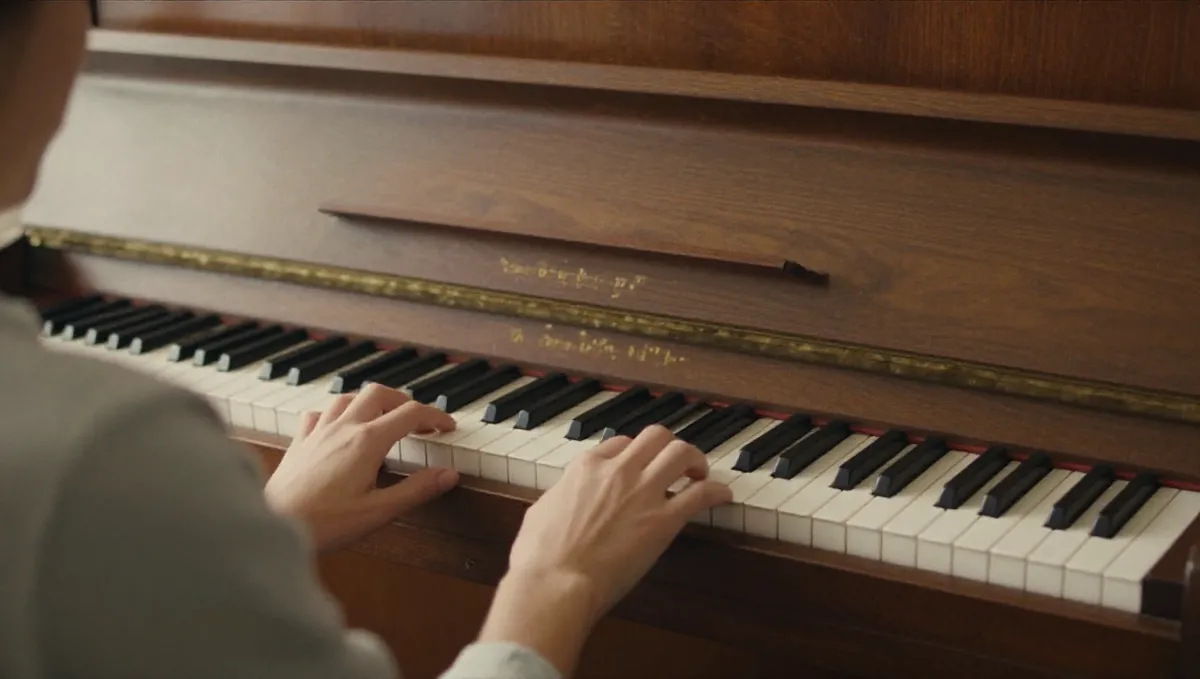
What a seventh adds to the triad you already play
A seventh chord is your triad plus the note a third above the fifth. If you already build triads by taking every other note of the scale (C, skip D, E, skip F, G), you just keep going one more step: skip A, land on B. C E G becomes C E G B.
There is a quicker way to find the seventh on the keyboard. It is the note just below the root's octave. For C, play the C above and step down: a half step down gives B, a whole step down gives Bb. Those are the only two sevenths you will meet in everyday chords.
The extra note changes how settled the chord feels. A plain C major triad sounds finished, the way the last chord of a hymn does. Add a seventh and the chord picks up color and a little ambiguity, as if the music hasn't quite stopped.
Two kinds of seventh, and how chord symbols tell them apart
The two sevenths are the major seventh, 11 half steps above the root (one half step under the octave), and the minor seventh, 10 half steps above the root (a whole step under the octave). Chord symbols tell you which one to use, and they also tell you whether the triad underneath is major or minor.

| Symbol | Triad | Seventh | Name | Example in C |
|---|---|---|---|---|
| maj7 | major | major (11 half steps) | major seventh chord | Cmaj7 = C E G B |
| m7 | minor | minor (10 half steps) | minor seventh chord | Cm7 = C Eb G Bb |
| 7 | major | minor (10 half steps) | dominant seventh chord | C7 = C E G Bb |
The row that trips people up is the last one. A plain 7 with nothing else does not mean a major seventh. It means a major triad with a minor seventh on top, and that chord has its own name: the dominant seventh. To get the major seventh you have to write "maj7" (some charts use "M7" or a small triangle).
So Cmaj7 and C7 are one note apart. Cmaj7 has B, C7 has Bb. On paper that looks like a detail; in the ear they are nearly opposite. Cmaj7 can end a song. C7 sounds like it is about to go to F.
How Cmaj7, Am7 and G7 sound different
Cmaj7, Am7 and G7 are one of each type from the table, built on three different notes of the C major scale. They share most of their notes, yet Cmaj7 feels like a resting place, Am7 like a gentler kind of minor, and G7 like a chord on its way somewhere else.
Cmaj7: the calm one with a slight rub
Cmaj7 is C E G B. The B sits a half step under the next C, and that close distance gives the chord a faint shimmer, a gentle friction you can hear if you play C and B together on their own. Inside the full chord it comes across as warm and a little wistful rather than harsh.
It still works as a home chord. You can end a phrase on Cmaj7 and it feels like arriving, just with softer edges than plain C. That is why it turns up so often in soul ballads, bossa nova and mellow pop, where a straight major triad would sound too plain.
Am7: minor, but less heavy
Am7 is A C E G. Look at the top three notes: C E G is a complete C major triad. That hidden major chord is why Am7 sounds less dark than plain A minor. The sadness is still there, but it is rounded off, more reflective than mournful.
Am7 and C6 (C E G A) contain exactly the same four notes. What decides the name is the bass. With A at the bottom you hear Am7; with C at the bottom you hear C6. If a friend's chart says C6 and yours says Am7 over the same bar, check what the bass player is doing.
G7: the one that won't sit still
G7 is G B D F. Hold it and stop, and you will feel the music hanging. The chord sounds like a question, and almost anyone, trained or not, can hear that it wants to move on. That tension is the whole point of the chord.
A quick way to tell the three apart by ear: maj7 sounds settled but colored, m7 sounds soft and slightly dark, and the dominant 7 sounds unfinished.
Why G7 pulls so hard toward C
G7 pulls to C because two of its notes sit right next to notes of the C chord and want to slide into them. B is a half step below C, and F is a half step above E. When G7 moves to C, B rises to C and F falls to E, and both tensions resolve at the same moment.
G is the fifth note of the C major scale, which is called the dominant, and that is where the name "dominant seventh" comes from. B, the third of G7, is the leading tone of the key, the note that leans upward into the tonic. A plain G triad already has that B, which is why G to C sounds like an ending. Adding F gives a second pull in the opposite direction.
B and F are also a tritone apart (six half steps, exactly half an octave). It is the most unstable interval you can find inside a major scale, and G7 is the only chord in C major that has both the tritone and the dominant root. Play G to C, then G7 to C, back to back. The second version lands harder.
The seventh chords that belong to C major
If you stack every other note of the C major scale on each degree, you get one seventh chord per degree, all using only white keys:

| Degree | Chord | Notes | Type |
|---|---|---|---|
| I | Cmaj7 | C E G B | major seventh |
| ii | Dm7 | D F A C | minor seventh |
| iii | Em7 | E G B D | minor seventh |
| IV | Fmaj7 | F A C E | major seventh |
| V | G7 | G B D F | dominant seventh |
| vi | Am7 | A C E G | minor seventh |
| vii | Bm7b5 | B D F A | half-diminished seventh |
Two things stand out. There is only one dominant seventh in the key, on the fifth degree, which is part of why G7 points so clearly at C. And the chord on B is odd: a diminished triad (B D F) with a minor seventh (A), written Bm7b5 and called half-diminished. It shares B, D and F with G7, so it can stand in for G7 when you want a darker approach to C. In minor keys it shows up a lot as the chord before the dominant, for example Bm7b5 to E7 to Am in A minor.
Trying seventh chords in a progression you already know
The easiest experiment is to take a four-chord song you can already play and swap each triad for its seventh from the table above. C, Am, F, G becomes Cmaj7, Am7, Fmaj7, G7. Play both versions in a row and you'll hear the second one turn softer and more flowing, with more pull back to the start each time G7 comes round.
Don't change everything at once on a real song. Go one chord at a time:
- Change G to G7. This is the safest swap and almost always works in a major key when G leads back to C.
- Change Am to Am7. It rarely clashes, since the added G is already in the key and usually fits the melody.
- Try Cmaj7 and Fmaj7 last, and listen to the melody over them. These are the ones most likely to rub (more on that below).
Once that feels natural, try the ii-V-I in C: Dm7, G7, Cmaj7. It moves from soft (minor seventh) to tense (dominant) to home (major seventh), and it is the backbone of a huge number of jazz standards. Notice how little your hand moves on piano: going from Dm7 to G7, the C in Dm7 drops a half step to B and everything else stays close.
Playing them on piano and guitar without a muddy sound
Four notes packed tightly in a low register sound thick and grey. The fix is to spread the notes out and keep the low end simple.
On piano, play only the root in the left hand, low, and put the rest in the right hand around middle C. For Cmaj7 that is C in the left hand and E G B in the right. If it still sounds cluttered, drop the fifth (G). The third and the seventh are what tell the ear which kind of seventh chord it is, while the fifth adds very little. A right hand of just E and B over a low C still reads clearly as Cmaj7.
On guitar, these open shapes are a good start (strings from low E to high E, x means don't play that string):
- Cmaj7: x32000
- Am7: x02010
- G7: 320001
Cmaj7 is just a C chord with your first finger lifted, so the open B string rings in place of C. Am7 is an A minor chord with the third finger lifted so the open G string sounds. G7 puts F on the first fret of the high E string. Switching between triad and seventh shapes like this is a quick way to hear exactly what that one note changes.
When to leave the seventh out
Color everywhere stops being color, and in a few common spots a plain triad simply does the job better.
The melody sits on the root. If your melody holds a C while the chord is Cmaj7, the C rubs against the B a half step below it. Sometimes that clash is lovely, often it just sounds wrong. Either play plain C under that note or drop the B from the chord for that beat.
The style wants weight, not shimmer. Punk, hard rock, big singalong choruses and many folk songs get their punch from plain triads. Turning every chord into a maj7 or m7 there makes them sound polite and vague.
Every chord already has one. If the whole song is maj7 and m7, nothing stands out, and you lose the contrast that makes G7 to C satisfying. This is how songs end up sounding like hotel lobby music.
G is home. In a song in the key of G, ending on G7 instead of plain G leaves the piece hanging, because the ear expects C next.
Try it now on MuziAI
Free, no sign-up required. Share an idea, and our AI lyrics generator writes and sings a complete song.
Create Song