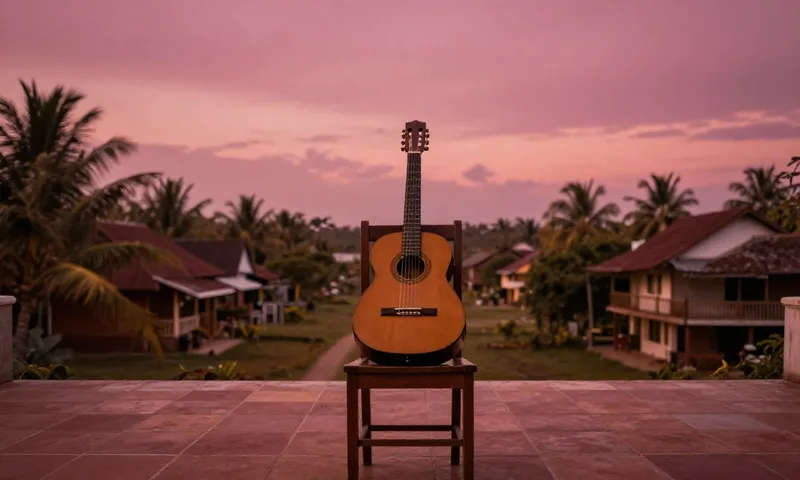
AI Music Bolero
Bolero uses a slow rumba rhythm, classical guitar, and long vocal notes. Common themes are homeland, distant love, and longing.
2 songs. Create one like this.
Bolero on MuziAI has just 2 AI-sung samples so far, both in Vietnamese, both at 72 BPM, both 76 bars and about 4 minutes 10 seconds long. The standout figure is the widest melodic range of all 19 genres MuziAI has measured: a median of 26 semitones. Two songs is a tiny sample; this describes MuziAI's two samples, not the rules of bolero.
Measured profile
Figures are read from the score the system writes for each song. The right-hand column is Vietnamese folk, the other Vietnamese-language genre at 72 BPM.
| Metric | Bolero (2 songs) | Vietnamese folk (2 songs) |
|---|---|---|
| BPM | 72 for both | 72 for both |
| Key written in the score | F major 1, G major 1 | F major 2 |
| Length | 250 to 252 s | 241 to 360 s |
| Bars (median) | 76 | 97 |
| Chords per bar | 1.10 | 0.65 |
| Vocal range | 26 semitones | 23 semitones |
| Voice | male 1, duet 1 | duet 1, female 1 |
| Language | Vietnamese 2 | Vietnamese 2 |
One folk sample has no chords written at all, which pulls its median to 0.65; the boleros are more clearly harmonised and more even in length. Against the ballad, also at 72 BPM, bolero runs longer (median 251 seconds against 208) and reaches 9 semitones wider. One detail needs a careful read: the score names a major key, yet both loops revolve around the relative minor. "Bóng Mẹ Hiên Xưa" is written in F major but moves Dm, Gm, C; "Hẹn Ngày Trở Về" is written in G major but opens Em, Bm, C, D. What you hear is a minor colour.
How MuziAI builds this genre
The style description sent to the singing model opens with "Vietnamese bolero, slow rumba rhythm, classical guitar, nostalgic, emotional vocal". Both songs add acoustic guitar. "Bóng Mẹ Hiên Xưa" picks a nostalgic mood and melismatic runs; "Hẹn Ngày Trở Về" picks a sad mood with strings and call-and-response. MuziAI says plainly that its singing model was not trained specifically on Vietnamese bolero.
Inside the samples
The two share an almost identical layout: a 9-bar intro, a 16-bar verse, an 8 or 9 bar chorus, another 16-bar verse, a chorus, a short third verse, a final chorus and an outro. Neither has a pre-chorus or bridge; the third verse (4 and 8 bars) does the bridge's job. Even the sung note counts are close: 229 and 226.
The differences are voice and harmony. "Bóng Mẹ Hiên Xưa" is a male vocal spanning 24 semitones over Dm, Gm, C closing on Bb, at 0.99 chords per bar. "Hẹn Ngày Trở Về" is a duet spanning 29 semitones over a five-chord loop, Em, Bm, C, D, G, changing more often (1.22). The wider range may partly come from two voices sharing one vocal line, but two songs cannot separate that from chance.
Getting better results
- Keep the speed on "Slow". No bolero sample uses anything but 72 BPM.
- Plan length by verse count. Three verses and three choruses gave about 4 minutes 10 seconds; drop the third verse for a shorter song. The lyric writer can lay out stanzas.
- For two singers, choose duet plus call-and-response, and expect a wide melody.
- Borrow the minor colour through the existing-score panel on the song generator: pick one of the two samples and keep "melody + chords" or "melody only".
- Check the words by ear. In one Vietnamese lyric clarity test, the bolero scored 0.786, below the ballad (0.947) and pop (0.909). If words get swallowed, regenerate or rewrite the awkward lines.
Limits
Two songs cannot show that bolero "always" runs four minutes or spans so wide; the 26 could change with a third sample. The rumba rhythm is requested, but the data does not measure rhythm. The clarity test has one song per genre. Listen for yourself in the sample library.